
Beta Delta Chapter History
Beta Delta Chapter · Beta Theta Pi at Cornell University
The ideals articulated by those founding members — scholarship, friendship, and moral character — would prove durable enough to carry the fraternity through nearly two centuries of American life, war, social upheaval, and change. The story of Beta Theta Pi at Cornell University is, in many ways, a chapter within that larger story: a local expression of a national brotherhood, shaped by the distinctive culture and traditions of one of America’s great research universities.
Founding of Beta Theta Pi (1839)
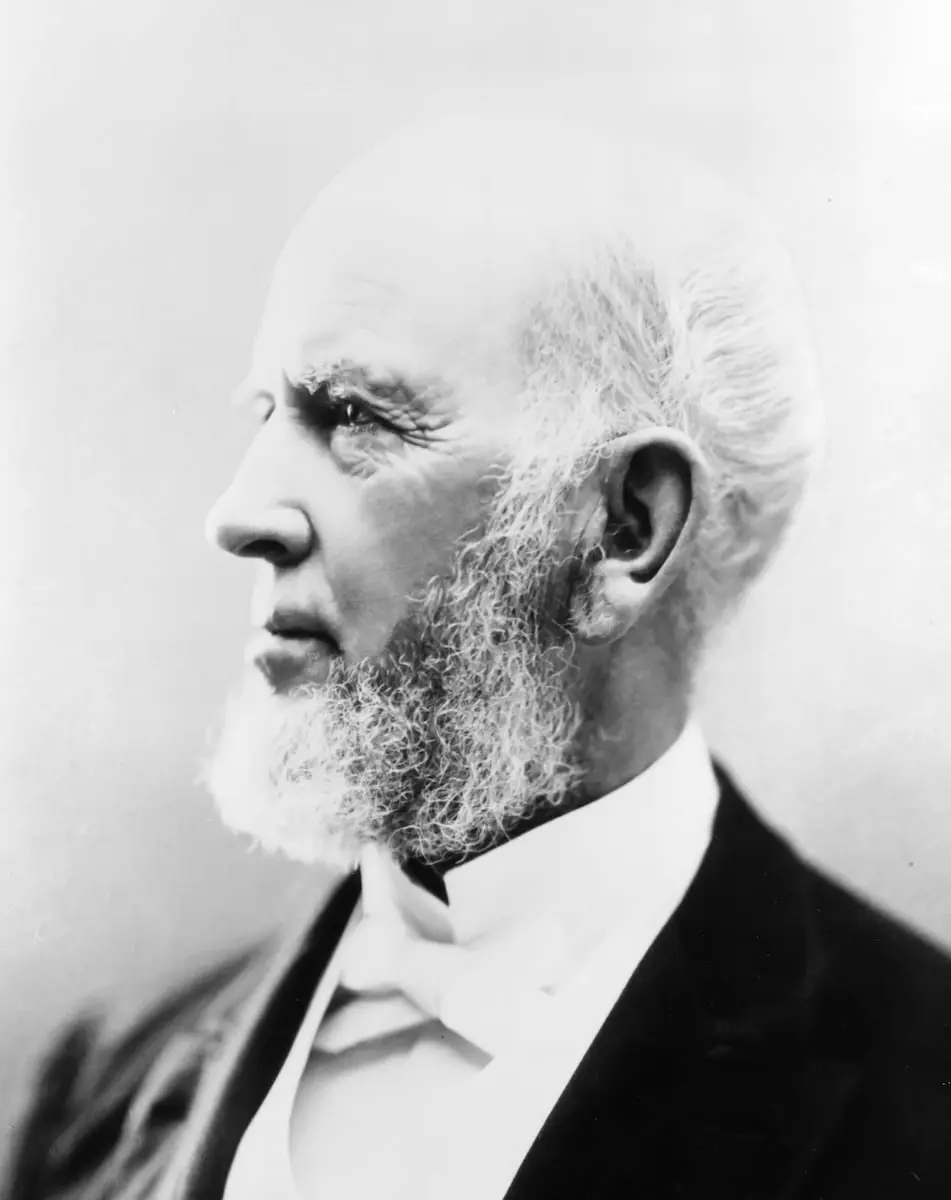
Beta Theta Pi was founded on August 8, 1839, at Miami University in Oxford, Ohio, led by John Reilly Knox and seven other undergraduates, during a formative period in the development of American collegiate life. As the first fraternity established at Miami University — and the first founded west of the Allegheny Mountains — Beta helped establish many of the organizational patterns and ideals that shaped early Greek‑letter life. It later became recognized as the earliest member of the Miami Triad, followed by Phi Delta Theta in 1848 and Sigma Chi in 1855.
From its beginnings, the fraternity embraced principles that guided its identity across generations: a commitment to intellectual development, the cultivation of lasting friendships, and the expectation of honorable conduct. Over the decades that followed, Beta Theta Pi expanded steadily throughout the United States, developing a national presence rooted in literary tradition, mutual support, and the cultivation of lifelong brotherhood.
Today, Beta Theta Pi encompasses 138 chapters, approximately 20 colonies, more than 10,000 collegiate members, over 142,000 living alumni, and more than 223,000 lifetime initiates — a national brotherhood whose scale reflects the enduring strength of the ideals first articulated at Miami University.
It was within this broader evolution of American fraternity life that the organization eventually established a presence at Cornell University through the formation of the Beta Delta Chapter.
Alpha Sigma Chi: The Precursor at Cornell
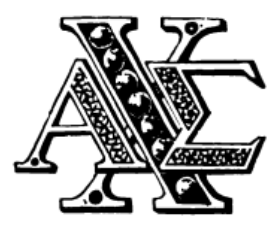
Long before the Beta Delta chapter carried its present name, its history began under a different banner entirely. The story traces back to Blairstown, New Jersey, where a small pre‑collegiate society known as S.A.C. was founded at Blair Academy by three friends — Louis la Tourette, Elbridge Van Syckel, and Ellis D. Thompson. As the founders moved on to college, each carried the spirit of the organization with him. At Rutgers College, Van Syckel quietly continued the group sub rosa beginning on October 10, 1871, and in 1874 he formally organized it as Alpha Sigma Chi together with Charles Washburg and William Watson. That same year, Thompson established the fraternity’s Beta chapter at Cornell University in February 1874, planting the roots of what would become one of Cornell’s longest‑standing fraternal traditions.
The Cornell chapter took root in an era when the university itself was still young, having opened its doors in 1868 — just six years before Alpha Sigma Chi’s arrival. Alpha Sigma Chi stepped into a dynamic and highly volatile Greek climate: twelve fraternities had been chartered at Cornell prior to 1874, though two had already folded before Alpha Sigma Chi arrived. During Alpha Sigma Chi’s five years on campus, three new fraternities were established while three existing chapters closed. Amid this early institutional turnover, Alpha Sigma Chi offered fellowship, intellectual community, and a sense of organized belonging. Though modest in scale, the chapter developed its own strong identity, laying a resilient foundation that would carry forward into its 1879 merger with Beta Theta Pi and sustain its unbroken operation to the present day.
The Birth of Beta Delta: The Merger of 1879

By the late 1870s, the leadership of Alpha Sigma Chi had grown increasingly aware of the limits imposed by the fraternity’s relatively small size. Having initiated approximately 223 members across its chapters, Alpha Sigma Chi was a respectable but modest presence in the broader landscape of American collegiate fraternities. Seeking greater stability, broader influence, and the resources that came with membership in a national organization, Alpha Sigma Chi’s leaders explored affiliation with a larger body.
Much of this momentum was driven by William Raimond Baird of the Stevens chapter, who undertook an exhaustive study of American fraternities in search of a national organization suitable for union with Alpha Sigma Chi. His research identified Beta Theta Pi as the strongest and most compatible partner, setting the stage for the decisive vote that followed.
That decision came in October 1879, when delegates of Alpha Sigma Chi convened in Ithaca for their eighth national convention, one that would transform the fraternity’s future. At that meeting, the members of Alpha Sigma Chi voted to merge with Beta Theta Pi. The decision was consequential not only for Alpha Sigma Chi’s members, but for Beta Theta Pi itself: the merger brought with it a significant influx of members and chapters, helping to make Beta Theta Pi one of the largest fraternities in the United States at the time.
For Cornell’s chapter, the merger was the moment of founding in its present form. The Beta chapter of Alpha Sigma Chi was rechartered as the Beta Delta chapter of Beta Theta Pi, anchoring Beta Theta Pi’s presence among the leading universities of the American East. From that October in 1879, the chapter has operated without interruption — a record of continuous activity that makes Beta Delta one of Cornell’s oldest fraternities and one of Beta Theta Pi’s most enduring chapters anywhere in the country.
The chapter’s earliest known poem, written by Henry Walter Wilhelm, Class of 1880 — an Alpha Sigma Chi member who became a Beta through the 1879 merger — is preserved on a separate page for reference.
Beta Delta Chapter Poem (1880)
Beta Delta in the Late 19th and Early 20th Century
Near the turn of the 20th century, a lasting General Fraternity tradition was born directly inside the Cornell chapter. Morris R. Ebersole, Class of 1898 (Cincinnati), while pursuing graduate studies at Cornell in the late 1890s, devised the very first fraternity “shingle”—an engraved membership certificate designed to be framed and displayed by active members. Ebersole’s design gained widespread popularity across the country, leading the 1913 General Convention to mandate that all chapters issue official shingles to their initiates. Refined by Beta’s heraldic authority Major George M. Chandler, the official shingle—featuring the fraternity coat of arms, member initiation date, and red wax chapter seal—remains one of Beta Theta Pi’s most recognizable national traditions.
As the chapter entered the early 20th century, Cornell’s Greek system was still developing, shaped by the social norms and limitations of the era. Fraternities played a prominent role in campus life, but membership was restricted in ways that reflected broader patterns in American society. Within this environment, Beta Delta brothers left a distinctive mark on Cornell’s emerging cultural identity.
In 1904, Romeyn Berry, Class of 1904 wrote The Big, Red Team, the song whose title soon became the enduring nickname for Cornell athletics — “Big Red.”
Just a year later, in 1905, brothers Charles E. Tourison, Class of 1905, W. L. Umstad, Class of 1906, and Bill Forbes, Class of 1906 penned the lyrics to Give My Regards to Davy, the spirited campus song that remains one of Cornell’s most recognizable and beloved fight songs.
These cultural contributions placed Beta Delta at the heart of Cornell’s musical and athletic identity during a formative period in the university’s history, and they remain all the more remarkable given that Charles E. Tourison — composer of The Big, Red Team and co‑author of Give My Regards to Davy — died only a few years later at the age of 23.
The early 1900s produced one of the most consequential — and largely unseen — intersections between Beta Delta’s history and the broader evolution of American fraternity life. During this period, Henry Arthur Callis, a Cornell pre‑medical student, worked in the Beta Theta Pi house to support himself while attending the university. His employment placed him inside the daily operations of a thriving chapter at a time when Black students were barred from joining White fraternities, giving him direct exposure to the structure, governance, and organizational discipline that defined fraternity life in the era. It was in this setting that Callis became a central figure in the formation of Alpha Phi Alpha Fraternity, Inc., founded in 1906 and incorporated in 1907 as the first intercollegiate African American Greek‑letter fraternity. (Some older secondary sources, including Wikipedia, claim that George Biddle Kelley worked at Beta instead; however, Christine G. O’Malley’s 2019 article First of All provides stronger documentation placing Callis at Beta and Kelley at Phi Kappa Psi.)

Meeting minutes kept by the group between October and December 1906, along with statements by Callis in his biography, reveal how significant this setting became. The planning meeting for Alpha Phi Alpha’s first banquet took place in Callis’s room in the servants’ quarters of the Beta Theta Pi house, and it was in this very room that the students officially selected the name Alpha Phi Alpha and chose black and gold as their official colors. Furthermore, Callis — who would go on to become one of Alpha Phi Alpha’s celebrated ‘Seven Jewels’ (its seven founders) — drafted the fraternity’s first constitution alongside Eugene Kinckle Jones (also one of the Seven Jewels) in that same room. As historians have noted, these moments reflect a striking historical irony: excluded from membership and permitted in elite white fraternity houses solely as employees, Callis and Jones paradoxically possessed a degree of interior access that allowed them to use the physical space of the servants’ rooms as a crucible for their own organization. They used those quarters to build a framework for a new group identity, turning a space of exclusion into the birthplace of their own organization. These moments stand as remarkable historical intersections: the operational model of an exclusionary system inadvertently helped inspire the creation of a fraternity that would become a cornerstone of Black collegiate life and a national force for leadership and advancement, whose membership has included figures such as Martin Luther King Jr., Thurgood Marshall, W. E. B. Du Bois and many others.
Chapter Houses and The Castle on the Rock
In 1901, the chapter commissioned its first purpose-built lodge at 17 South Avenue. A building fund for a future permanent home had been established as early as 1891, an effort that ultimately culminated in the South Avenue project a decade later. Designed by Williams of Buffalo and built by Allington & Son of Elmira, the new house sat on a West Campus lot between Theta Delta Chi and Sigma Chi. While the lodge served the growing chapter well, expanding membership eventually outgrew the space.

According to a December 20, 1912 report in the Cornell Daily Sun, Beta Delta sold the 17 South Avenue property in 1913 for $29,000 to Alpha Theta (a local fraternity that later affiliated with Pi Kappa Alpha in 1917). Having already purchased a spacious lot in Cornell Heights from Professor Jeremiah W. Jenks, the chapter temporarily returned to 523 East Buffalo Street while plans and construction progressed for its permanent new estate.
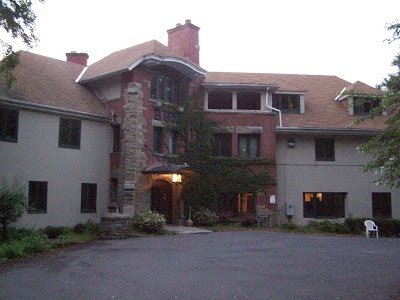
That home arrived in the early years of the twentieth century, in the form of a Gothic‑Revival structure perched on a rocky promontory just north of the Cornell campus at 100 Ridgewood Road. By the time the chapter moved into the house in 1915 or 1916, its dramatic stone construction and elevated site had already earned it the enduring nickname “Castle on the Rock.” The house was designed by architect Thomas J. George, Cornell Class of 1895, of Clinton, Russel & Co., and built by the Whitney Construction Co. of New York City. Contemporary reports described the design as Norman and “entirely unique,” noting that the planned house would be the largest fraternity house in Ithaca when completed. The original six‑acre tract, which included a stream running through the property, was to be terraced and enclosed by a fifteen‑foot stone wall, creating the dramatic hillside setting that still defines the site. A portion of this original tract was later subdivided and became the parcel now known as 40 Ridgewood Road, a property that has long been part of Cornell’s Greek community.
Inside, the lower floor featured an open sweep of one hundred feet through its three principal rooms, and the house was designed to accommodate about thirty men. Completed in the early 1910s, the Castle expressed the chapter’s confidence and ambitions, commanding sweeping views toward Cayuga Lake. The house stands today on a 4½‑acre estate‑style parcel spanning both the City of Ithaca and the Village of Cayuga Heights, including the wooded hillside descending to Stewart Avenue — the largest known fraternity property at Cornell and among the largest Greek‑house parcels in the nation, a defining part of the chapter’s physical identity.
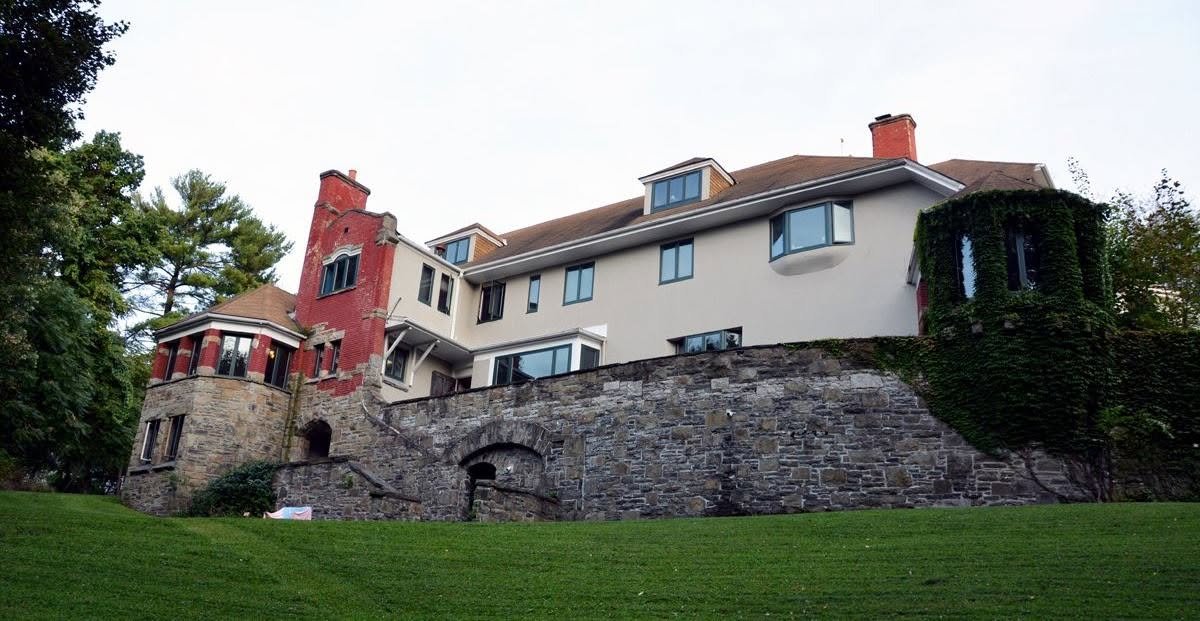
For more than a century, 100 Ridgewood Road has served as far more than a place to sleep and study. It has been the gathering place for generations of Beta Delta initiates, the setting for decades of formal dinners and chapter meetings, and the stage upon which friendships have formed that have lasted entire lifetimes. Maintained and periodically renovated through the combined efforts of the undergraduate chapter and its alumni house corporation, the Castle has been carefully preserved without sacrificing the historic character that makes it so distinctive.
Today, the Castle on the Rock stands as one of Cornell’s most recognizable fraternity homes. Its architecture speaks to the era that shaped it, while its continued vitality reflects the living brotherhood that has called it home for over a hundred years. More than a building, it is a symbol of Beta Delta’s permanence — a landmark that connects every generation of Cornell Betas to those who came before them.
Service and Sacrifice: The World War Era
The early and mid-twentieth century brought profound disruptions to American life, and Beta Delta — like colleges and fraternities across the nation — was not insulated from them. During both World War I and World War II, significant numbers of undergraduate members left Cornell to serve in the armed forces. Enrollment declined, chapter life was curtailed, and the rhythms of fraternity life were interrupted by the demands of global conflict. Through both of these difficult periods, however, the chapter persisted — maintaining its identity and its traditions even as the world outside the Castle changed dramatically.

Jefferson Vincent, Class of 1910, served during this era. A standout of Cornell’s early hockey program, he played a key role in the team’s dramatic overtime victory over Harvard that secured the 1911 national title. After graduation, Vincent joined the U.S. State Department and served as a diplomat in Spain, where he contributed to efforts that helped maintain Spanish neutrality during World War I. He later enlisted for military service and was ultimately killed in action, his life reflecting the full and spirited paths taken by many young men who soon found themselves in uniform.
As the chapter’s wartime history continued into the next generation, one name stands out for the extraordinary things Beta Deltas have done in the wider world. Eric Erickson, Class of 1921, later served with the Office of Strategic Services during World War II, carrying out daring and consequential work behind enemy lines in support of the Allied cause. His story — one of extraordinary courage conducted largely in secret — captured the imagination of a later generation when it inspired both a book and a major motion picture: The Counterfeit Traitor. Erickson’s life is a reminder that the ideals of leadership and character instilled within Beta Theta Pi can find expression far beyond the fraternity house.
Across both world wars, many Beta Deltas left Cornell to serve in roles that carried them far from campus and into the center of global conflict. Some returned home after distinguished service; others did not. The chapter remembers with solemn respect those brothers who gave their lives in the line of duty. Their names, preserved in the chapter’s history, appear in the memorial below.
1920s and 1930s: Prohibition and Interwar Traditions
For decades, the Coors Brewing Company maintained a quiet but cherished connection to the Beta Delta chapter. Each year, the brewery sent beer to the house — a gesture of fraternal loyalty rooted in the fact that three Coors brothers, Adolph Coors Jr., Class of 1907; Herman Frederick Coors, Class of 1910; and Grover Cleveland Coors, Class of 1913 had all been initiated into Beta Delta during the early twentieth century. It was a tradition remembered fondly by generations of members, a reminder that three brothers from Golden, Colorado had once found their own fraternal home in Ithaca.
That connection, of course, paused during Prohibition. Colorado entered statewide prohibition in 1916, four years before the national ban took effect in 1920, and the Coors shipments ceased. Yet the chapter’s social life adapted in ways that became part of its own lore. During the Prohibition era — a time when alcohol was illegal nationwide and social life on college campuses adapted in unusual ways — Beta Delta maintained a small private gathering space known as the Subterrace Café. Tucked into a storage room beneath the back terrace, the Café became a private refuge for camaraderie — and, according to long‑standing chapter stories, its supply was occasionally supplemented by liquor brought in from Canada.
In 1926, right in the middle of national Prohibition, the chapter made a highly publicized donation of a complete 26‑volume set of Joseph Conrad’s works to the newly established Willard Straight Hall Library. The gift underscored how Beta Delta maintained a public image of cultural refinement, intellectual seriousness, and campus leadership even as its private social life adapted to the restrictions of the era.
Throughout the late 1920s and into the 1930s, the chapter house at 100 Ridgewood Road also served as a high‑society cultural venue. The brothers regularly hosted annual art exhibitions in the Castle’s grand common rooms, opening with private evening previews for invited faculty, administrators, and local Ithaca guests. These events showcased works by prominent Cornell art professors and regional professional artists, reinforcing the chapter’s reputation as cultivated and civically engaged. During the 1920s, these exhibitions functioned much like the Conrad donation — a strategic social shield that projected refinement and intellectual seriousness at a time when fraternities faced intense scrutiny under Prohibition. After the repeal of Prohibition in 1933, the exhibitions continued with a new purpose: signaling stability and institutional strength during the Great Depression, when fraternities nationwide struggled financially and membership declined. By maintaining a visible program of cultural patronage, Beta Delta demonstrated to parents, alumni, and university trustees that the chapter remained an educational asset to Cornell, not a frivolous luxury. Whether defending against Prohibition‑era policing or weathering the economic turmoil of the 1930s, the Castle Art Exhibitions consistently helped the chapter control its public narrative and preserve its standing within Cornell’s social hierarchy.
Though the Subterrace Café disappeared after the repeal of Prohibition, its memory endured as one of the most colorful examples of the chapter’s resilience and creativity during a turbulent period in American history. Its memory endures today not as a model for modern fraternity life, but as a reflection of how students navigated the unique constraints of the Prohibition era.
Leo Love
“Of Ever Honored Memory”
Many hundreds of young men have passed through the doors of the Castle on the Rock over the years, each leaving his own mark on the chapter’s history. But among all those who have shaped the character of Beta Delta, few are remembered with the warmth and reverence reserved for Leo Love — the chapter’s longtime houseman, and, in time, a full member of the brotherhood itself.
Leo came to live at the Castle in 1935, and for the next sixteen years he was a constant and beloved presence. In 1951, he married Hazel Shirley, and though he moved out of the house, his dedication to Beta Delta remained undiminished. He continued working for the chapter until 1964 — nearly three decades of devoted service.
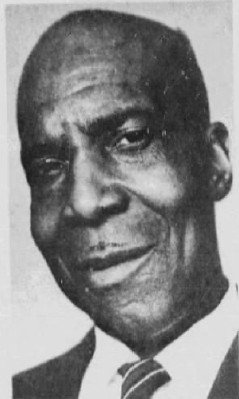
His commitment transcended any formal role. In recognition of his devotion, at the centennial celebration, the chapter initiated Leo as a full member — an honor he received with characteristic grace. Chapter lore holds that he never missed a single meeting thereafter.
Beyond his life at the Castle, Leo was deeply engaged in the Ithaca community. He served as chairman of the board of trustees of St. James AME Zion Church, as president of the Tompkins County NAACP, and as treasurer and trustee of the Forest City Lodge of Elks. His was a life of service — to the fraternity, to his faith, and to his community.
Even after Leo’s passing, his presence has never quite left the Castle. Chapter tradition holds that his spirit lingers in the room at the far end of the long hall on the left side — the very room, it is said, that Leo once confided he would have most liked to call his own. For the Betas who have lived and studied beneath that roof ever since, Leo Love remains not merely a memory, but a presence — a reminder of what it truly means to belong to a brotherhood.
The 1950s: Post-War Growth and Institutional Courage
The years following World War II brought a period of remarkable expansion to American higher education, and Cornell was no exception. The Servicemen’s Readjustment Act of 1944 — better known as the GI Bill — enabled hundreds of thousands of veterans to attend college who might otherwise never have had the opportunity, and university enrollments surged across the country as a result. At Cornell, this wave of returning veterans and newly enrolled students filled fraternity houses that had grown quiet during the war years.
The early 1950s also brought a moment of solemnity to the chapter. During the Korean War, Beta Delta brother Gerald W. Carpenter, Class of 1949, was killed in action on 26 July 1951 — the chapter’s sole Gold Star loss of that conflict.
During this same period, Cornell President Deane W. Malott — a member of Beta Theta Pi initiated at the University of Kansas — emerged as a nationally recognized defender of academic freedom during the McCarthy Era. At a time when universities across the country faced intense pressure regarding political associations, Malott publicly defended academic freedom and criticized McCarthyism while maintaining an environment where current issues could be freely discussed. His stance helped preserve the academic stability of the university during a perilous moment in American higher education, shaping the broader environment in which Beta Delta continued to thrive.
The 1950s also produced several documented examples of the chapter’s civic engagement. In May 1954, thirty members manned donated trucks in a community scrap‑collection drive to raise funds for Kiwanis baseball, reflecting the chapter’s active role in local community service during this period.
Amid this period of service and campus engagement, the chapter also developed one of its most memorable traditions — the story of Murph. In the mid‑1950s, several brothers traveled to Johns Hopkins to attend a lacrosse game. At a nearby intersection, a stray dog wandered toward their car; when they opened the door, she jumped in without hesitation. The brothers brought her back to Ithaca, where Jon Lindseth, Class of 1956, adopted her and named her Murph.
As Lindseth later recalled for some undergraduates in the 1970s, Murph’s name came from a humorous song from that era. Lindseth often shared this detail when telling the story, and it remained part of the chapter’s oral history for decades.
When Murph passed away, Lindseth and the brothers held a full funeral in the backyard of the Castle — complete with a gravestone — and buried her on the grounds. The undergraduate brotherhood has tended her grave for over seventy years, preserving a small but cherished symbol of the affection, humor, and continuity that defined life at 100 Ridgewood Road during that era.
Murph’s story remained one of the chapter’s most affectionate traditions, a reminder of the humor and continuity that shaped daily life at the Castle. That same spirit of camaraderie extended beyond Beta Delta itself, and in 1959 the chapter briefly played an unexpected role in supporting another fraternity. A fire at the Tau Epsilon Phi house disrupted that fraternity’s normal operations, and for a period afterward its members came to the Castle for meals and held their chapter meetings at Beta Delta. The arrangement reflected the cooperative spirit that characterized Cornell’s Greek community in the mid‑century era and underscored Beta Delta’s reputation as a stable, dependable chapter willing to assist fellow fraternities when unexpected difficulties arose.
For Beta Delta, the 1950s were a time of genuine flourishing. Members were active across a wide range of campus organizations and athletic pursuits. Life at the Castle centered on the rhythms of close-knit brotherhood: formal chapter dinners, social gatherings, the cultivation of lifelong friendships, and the mentorship of younger members by older ones. Alumni engagement was strong, and the chapter enjoyed the kind of stability and vitality that define the classic model of mid-century fraternity life. It was, in the recollection of those who lived it, an era when the meaning of brotherhood was felt in the daily texture of life at 100 Ridgewood Road.
The 1960s: Upheaval and Integration
The relative stability of the post-war decade gave way, in the 1960s and early 1970s, to one of the most turbulent periods in American social and political history. The civil rights movement, the Vietnam War, and a broad generational questioning of established institutions reshaped virtually every corner of American life — and fraternity life was no exception. Across the country, Greek organizations faced intensifying scrutiny regarding their role on campus, their membership practices, and their compatibility with the evolving values of a new generation of students. Cornell itself experienced significant upheaval during these years, including the 1969 Willard Straight Hall takeover, which reflected the intensity of national debates playing out on college campuses.
The mid‑1960s brought a quiet but meaningful turning point in the chapter’s history. Although Beta Theta Pi never adopted an official racial or religious exclusion in its constitution, the fraternity had long operated in practice as a White, Christian organization. Nationally, progress toward integration was slow and often resisted. The first Black initiate in the fraternity’s history, Bill Lowry, entered the Kenyon chapter in 1954 — a decision made by the local chapter despite significant administrative intimidation and discouragement from the national organization.
Twelve years later, in January 1966, Gregg Morris, Class of 1968, became the first African American initiated into the Beta Delta Chapter. By a striking coincidence, both pioneers—Lowry, who broke the color barrier for the general fraternity, and Morris, who integrated Beta Delta—hailed from the South Side of Chicago. Morris’s path into the fraternity reflected the complexities of the era. Morris described his entry into the chapter as a “bait‑and‑switch” experience — unexpected and challenging for an eighteen‑year‑old who had not anticipated joining a fraternity at all.
Morris later explained that his reference to “bait‑and‑switch” stemmed from his freshman arrival at Cornell, when the modern residence‑hall room he had been shown during recruitment was replaced by a converted closet in an on‑campus dormitory. After he contacted assistant coach Jerry Lace, the basketball staff arranged a temporary solution with Beta Theta Pi: a better room at the house and meals there, though with the expectation that he would serve as a dinner aide in exchange for room and board. Morris took the room in the house but refused to be a dinner aide. The chapter allowed him to stay, aware that forcing him out could be interpreted as racially motivated and damage the fraternity’s reputation. Morris recalled that some members of the basketball staff were supportive and tried to help him navigate the situation, while others displayed attitudes he found prejudiced, adding to the strain of his first weeks on campus. Although he was promised new housing for his second year, he again found himself placed at Beta, but by that time he had formed close friendships with several brothers, including Clarence Jentes, Class of 1965, and alumnus Max Mattes, Class of 1955. Those relationships eased the tension of the earlier arrangement, and Morris ultimately chose to join the chapter, becoming a member before moving off‑campus with friends he had made at the house.
Morris’s initiation marked an important moment in the chapter’s evolution. It did not signal the end of racial barriers in the Greek system — at Cornell or nationally — but it represented a step toward a more inclusive membership at a time when fraternities across the country were confronting questions of identity, tradition, and change. Beginning in the 1970s and continuing into the decades that followed, many men of color became members of Beta Delta, reflecting both the chapter’s gradual evolution and the broader changes taking place at Cornell.
The 1970s: Tradition, Community, and Centennial
The early 1970s marked a period of stabilization for Beta Delta following the social upheavals of the previous decade. As campus tensions gradually eased, daily life at the Castle developed its own rhythms and traditions, reflecting a renewed sense of continuity within the chapter. One of the most memorable of these traditions was a spirited version of Four Square played on a modified court painted in the driveway in front of the main entrance. Instead of the traditional large rubber kickball, the house version used a tennis ball, which made the game faster and more competitive. Four players occupied the squares at any given moment, and on each turn one player could be eliminated and sent to “the crowd,” while a member of the crowd rotated into the game — creating a constant flow of players in and out. The crowd served as an informal panel of judges whose rulings were final, giving rise to a saying well‑known to Beta Deltas from that time period: “the crowd is justice, and justice is blind.” The game became a defining social ritual of the era and a memorable part of daily life at the house, reflecting the lighter, communal side of fraternity life during a time otherwise marked by institutional change. The tradition endured for over two decades, remaining a staple of house life through the early 1990s.
In 1979, the chapter marked a major milestone with the celebration of its Centennial. Co‑chaired by Chris Adams, Class of 1979 and Lance Greenberg, Class of 1976, the event brought together generations of Beta Deltas, including alumni whose involvement dated back to the 1930s. Two moments stood out during the weekend: the chapter’s re‑established connection with Leo Love, whose formal initiation into Beta Theta Pi became one of the celebration’s most meaningful highlights; and the keynote address delivered at the banquet by Robert Kane, Class of 1934, whose distinguished career in athletics and Olympic governance lent the occasion a sense of historical continuity and pride. The Centennial served not only as a commemoration of the chapter’s longevity but also as a reaffirmation of the bonds that had sustained it through decades of change.
The 1980s: Stabilization and Alumni Engagement
By the 1980s, the fraternity system at Cornell had reached a new equilibrium after the upheavals of the preceding decades. For Beta Delta, this era was defined by a determined focus on the fundamentals of chapter health: strengthening undergraduate membership, deepening the engagement of an extensive alumni network, and attending to the care and maintenance of the historic house at 100 Ridgewood Road. An increased emphasis on scholarship and leadership — values at the heart of Beta Theta Pi’s mission — helped the chapter reconnect with its founding ideals during this period of relative stability.
The alumni who remained closely involved with Beta Delta through the 1980s and 1990s provided an important continuity of tradition and institutional memory, helping to ensure that the bonds between successive generations of Cornell Betas remained strong. Their engagement with the undergraduate chapter would prove foundational for the challenges and opportunities that lay ahead.
The 1990s: Navigating a National Culture Shift
By the early 1990s, fraternities across the country were confronting a rapidly changing campus environment. The “Animal House” stereotype — once treated as harmless cinematic exaggeration — had evolved into a genuine liability, fueling high‑risk behavior, insurance crises, and increasing scrutiny from universities. Like many historic chapters, Beta Delta found itself navigating a decade in which the very future of the Greek system seemed uncertain.
The turning point came in 1998, when the General Fraternity took the unprecedented step of closing its own founding Alpha Chapter at Miami University over risk‑management violations. The decision sent shockwaves through the fraternity world and carried particular weight for older chapters such as Beta Delta, long recognized as one of Cornell’s most enduring fraternal institutions. The closure of Alpha forced a period of deep reflection at 100 Ridgewood Road, prompting the undergraduate chapter to reevaluate its culture, operations, and long‑term identity.
In the years that followed, Beta Delta aligned itself more intentionally with the fraternity’s core values and the emerging Men of Principle Initiative. The chapter’s response to the challenges of the 1990s played a significant role in preserving its continuity, ensuring that it remained not only active but institutionally strong as the fraternity system entered the twenty‑first century.
As the decade came to a close, the cultural reforms sparked by the Alpha Chapter closure and the Men of Principle initiative had reshaped expectations for fraternity life at 100 Ridgewood Road. With its values‑based foundation strengthened, Beta Delta entered the 2000s prepared to confront a new set of challenges — not cultural, but structural — as attention shifted from internal reform to the long‑term preservation and renewal of the Castle itself.
The 2000s: Renovation, Renewal, and Rebuilding
As the twentieth century drew to a close, alumni and undergraduate members of Beta Delta undertook a significant effort to preserve and modernize the Castle. Sustained alumni fundraising supported substantial renovations and improvements to the facility, culminating in a campaign that restored and formally rededicated the historic house. These projects were as much about community as they were about construction — they strengthened the ties between generations of Betas and demonstrated the enduring commitment of the chapter’s alumni to the house they had once called home.
The renovations were a cause for celebration, but the years that followed brought a more difficult test. Despite the improved physical condition of the Castle, the chapter faced serious challenges as undergraduate membership declined sharply during the 2000s. One contributing factor was the chapter’s early adoption of substance‑free housing — a standard not yet embraced by most other fraternity chapters at Cornell. While the decision reflected a principled commitment to the Fraternity’s core values, it also made recruitment more difficult during a period when social expectations on campus were shifting unevenly. By 2009, Beta Delta had reached a low point: just seven active undergraduate members remained on the chapter’s rolls. The situation demanded a coordinated response, one that would require renewed commitment from both the undergraduate chapter and its alumni.
That response came from multiple directions at once. The Alumni Corporation Board and a core group of committed undergraduates worked together with renewed urgency, launching a focused rebuilding effort. The General Fraternity provided crucial support — training in recruitment, chapter operations, and organizational development — that helped give the effort both structure and momentum. The results were swift and encouraging: by the spring of 2010, the active chapter had grown to more than twenty members. Beta Delta had turned a corner, and the chapter’s tradition of continuous operation was secure once more.
The 2010s: Engagement and Renewal
The momentum generated by the rebuilding effort carried the chapter into a new decade with renewed purpose. Operating within the modern regulatory environment for Greek life at Cornell University, Beta Delta in the 2010s placed a strong emphasis on scholarship, leadership development, and the principles of responsible brotherhood embodied in Beta Theta Pi’s Men of Principle Initiative.
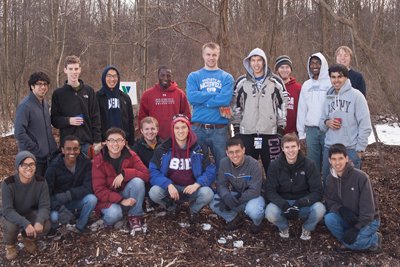
In January 2013, nearly twenty undergraduate members of Beta Delta partnered with Cornell Outdoor Education to assist the Ithaca YMCA in developing its 110‑acre Camp Adventure property. Working in fresh snow and mid‑winter conditions, the brothers helped build trails and prepare outdoor education areas that support summer programming for local children. COE Executive Director Todd Miner praised the fraternity’s reliability and spirit of service, noting their contributions to multiple trail projects. YMCA CEO Frank Towner recognized the effort as an important enhancement to one of Tompkins County’s most dynamic outdoor recreation initiatives.
In 2017, the chapter marked a significant milestone: the 100th anniversary of the Castle, celebrating more than a century of life at 100 Ridgewood Road — a moment for reflection on how much had changed, and how much had endured. The centennial offered brothers and alumni alike an opportunity to honor the generations who had lived, studied, and grown within its stone walls, and to recognize the Castle’s place as one of Cornell’s most distinctive fraternity homes. The anniversary reaffirmed the chapter’s commitment to preserving the Castle’s historic character while ensuring it remained a vibrant home for future generations.
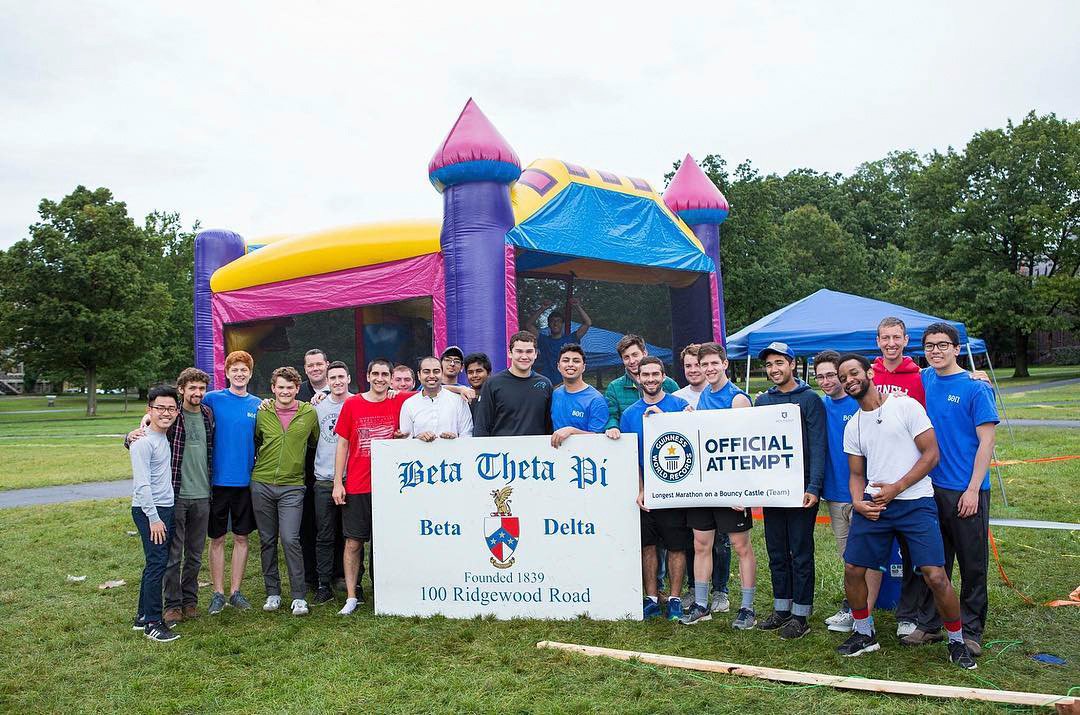
That spirit of creative engagement and community leadership again took center stage in September 2017 with an unprecedented philanthropy effort on the Arts Quad. In an event titled “Betas Bounce Against Sexual Violence,” a team of eight undergraduate brothers set out to break the Guinness World Record for the Longest Marathon on a Bouncy Castle (Team). Taking turns in non-stop rotation according to strict official rules, the brothers bounced for 50 continuous hours—surpassing the previous record of 43 hours and 25 minutes—while hundreds of students and community members joined in and bounced alongside them. The effort raised funds for Tompkins County’s Advocacy Center to support sexual violence prevention and education, demonstrating how undergraduate initiative could combine brotherhood endurance with impactful community outreach.
The 2020s: Challenge and Rebirth
When the COVID‑19 pandemic struck in 2020, Cornell University entered one of the most complex operational periods in its history. Travel restrictions, shifting federal policies, and uncertainty about international re‑entry left many students unable or unwilling to return home. As a result, a significant number of Beta Delta undergraduates — including several international brothers — remained in the Castle throughout the shutdown. Cornell closed most university‑owned fraternity houses during this period, but Beta Delta — as an off‑campus, privately owned chapter house — remained open and continued to operate under the university’s public‑health protocols. Cornell’s campus‑wide public health strategy, guided by its Agent‑Based Approach (ABA) modeling, relied on frequent asymptomatic testing, strict quarantine protocols, and controlled housing occupancy. These measures proved remarkably effective, and no cases of COVID‑19 were reported among the brothers living in the house during this period.
Even with the house occupied, traditional recruitment was impossible. Campus access was restricted, gatherings were limited, and many potential new members were isolated in dorms. In one of the most memorable acts of alumni support in the chapter’s modern history, Dan Leyva, Class of 2014, CEO of Wings Over, ensured that spring rush could continue despite these constraints. Leyva arranged regular deliveries of wings to the Beta house and coordinated pickup locations in dorm parking lots so that every potential new member — regardless of where they were living — could participate. His efforts provided connection and continuity during a semester defined by isolation, and reflected the enduring commitment of alumni to the chapter’s well‑being.
Although the COVID-19 pandemic forced recruitment entirely online via Zoom, student demand initially remained resilient, and chapters like Beta Delta maintained stable interest through aggressive digital outreach. The true contraction in Cornell’s Greek life membership occurred post-pandemic, driven by aggressive university mandates designed to restrict the recruitment pipeline. To curb misconduct, Cornell enforced strict structural reforms, including an 8:00 p.m. curfew on all rush activities, entirely substance-free rush windows, and a severe “minimum three-year suspension” policy. While Beta Theta Pi had pioneered substance-free housing nationally decades earlier through its Men of Principle initiative, the sudden, campus-wide enforcement of these strict policies flattened traditional recruitment channels across all houses—disproportionately affecting chapters navigating rebuilding efforts. This heightened administrative enforcement led to the swift shutdown of several major chapters and created a highly restrictive environment that caused undergraduate membership at Beta Delta to decline sharply, eventually falling to a low of just five active brothers.
Yet the response that followed was characteristic of the chapter’s long history: a brotherhood defined not by the ease of its circumstances, but by the strength of its response to adversity. With determined leadership from the undergraduate chapter, steadfast support from the alumni corporation, and assistance from the General Fraternity, a rebuilding effort was launched that defied the broader campus downturn. Navigating Cornell’s strict new regulatory landscape, the chapter successfully initiated twenty‑one new members during the 2025–2026 academic year—a class that restored genuine strength to the undergraduate brotherhood. That momentum carried directly into the following year: during the fall rush alone, Beta Delta pledged an additional fourteen upperclassmen, with spring freshman recruitment still ahead. These consecutive pledge classes have re-established a thriving active chapter and positioned Beta Delta for a future of sustained growth.
Today, the chapter is engaged in a major fundraising campaign to renovate and preserve the Castle for the generations of Cornell Betas who will follow. That campaign has accomplished something beyond its physical objectives: it has re‑engaged alumni across the decades and rekindled connections between the chapter and the broad community of men whose lives were shaped by their years at 100 Ridgewood Road. With the generous support of distinguished alumni including David Duffield, Class of 1962, and Jon Lindseth, Class of 1956, the chapter is working to ensure that the Castle remains not only standing, but vibrant — a home worthy of the next century of Cornell Betas.
An Enduring Brotherhood
More than 145 years after its founding, the Beta Delta chapter of Beta Theta Pi at Cornell University remains one of the university’s longest continuously active fraternities. It has survived two world wars, periods of cultural upheaval, the ebb and flow of membership, and the particular challenges of sustaining a historic building across more than a hundred years of use. Through all of it, the chapter has endured — sustained by a devoted alumni network, a resilient undergraduate membership, and an abiding commitment to the ideals of brotherhood, scholarship, and leadership that have defined Beta Theta Pi since its founding on a summer morning in Ohio in 1839.
As the Beta Delta chapter approaches its 150th anniversary, it carries forward a tradition that is at once deeply rooted in the past and genuinely alive in the present. The Castle on the Rock still stands. The brotherhood still gathers. And the best of Beta Delta, as it has always been, is yet to come.